The Hourglass Method: How to Write a Brand Statement From the Messy Middle
I’ve heard this sentiment again and again from brilliant business leaders trying to introduce their organization, their services, or even their personal career skill sets:
“Networking events give me anxiety because I fumble on what our company actually does.”
“I struggle to explain our value on introduction calls.”
“I just want to be able to explain my business in three words.”
“When I talk about what we do, I feel like I’m rambling.”
First impressions are unforgiving. You have less than five seconds to hook someone at a crowded networking event, a 25-minute introductory call, or while a prospect is passively skimming businesses on LinkedIn.
This is why companies obsess over their brand statement. A true brand statement is a crisp, powerful declaration that distills an organization’s very essence. It clearly communicates a core value proposition, sparks immediate intrigue, and lays the groundwork for market differentiation.
Yet, most leaders go about creating one completely backward.

The Two Creative Traps
When trying to define their message, leaders usually fall into one of two traps:
The Catch-All Trap: They say way too much. They lose the audience in industry jargon, lengthy service lists, and verbose, carry-on ideas that leave the listener with more confusion than clarity.
The Shortcut Trap: They try to skip the work and go straight to the final edit. They attempt to snatch three compelling words out of thin air that magically represent the depth of who they are.
The truth is, you cannot bypass the messy middle.
The Hourglass Framework
The way we create content and the way we present content are precise opposites. Think of it as an hourglass shape.
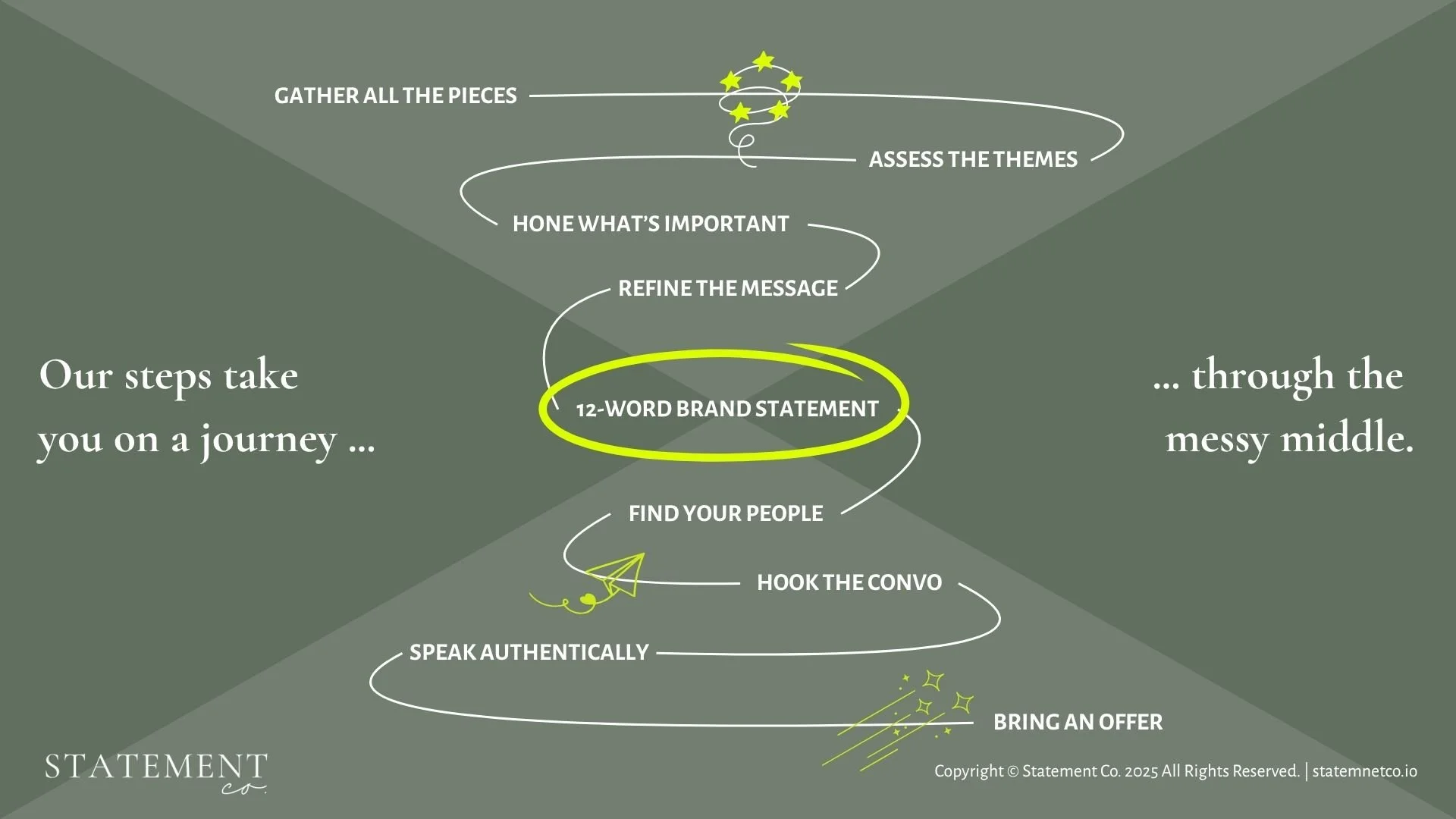
The Top Half: How We Create
We create by capturing all the details, nuances, data points, and ideas. We review the pile for themes—noticing what stands out and what resonates. We whittle down the ideas little by little until we are left with the absolute core: the distinct nugget that says it most directly.
The Bottom Half: How We Present
When we present, we do the exact opposite. We don't dump the whole hourglass on them at once. We share the sharp point—the core kernel of the idea—and invite the listener or reader to be curious. We give them permission to ask questions, scroll further, unpack more, and explore the details at their own pace.
You see this architectural pattern repeated everywhere:
Journalism: A news article states the entire thesis in sentence one, then spends the next ten paragraphs unpacking the details.
Web Design: A landing page features a bold hero statement above the fold, inviting you to scroll down into specific services or product pages.
Public Speaking: A great orator presents the big idea in their opening statement, then spends the next twenty minutes helping you grasp it through supporting stories.
How to Navigate the Messy Middle
To get to that sharp, executive-ready point, you have to intentionally move through the hourglass. It is a structured process of elimination. Here is how you do it:
Step 1: The Braindump. Capture every single data point you have across six categories: Who I am, What I do, How I do it, Why I do it, What makes me credible, and The action I want you to take.
Step 2: The First Edit. Circle the three most important words in each of those six sections.
Step 3: The Paragraph. Summarize each section into exactly one sentence, emphasizing those three critical words. Voila—you now have a cohesive “About Us” paragraph.
Step 4: The Second Edit. Circle the one most important word in each of those new sentences.
Step 5: The Sentence. Summarize all of those sentences into a single, unified sentence that emphasizes those core words. Voila—you have an “About Us” sentence.
Step 6: The Brand Statement. Circle the three most important words in that sentence. Remove all filler, cutting the length down to 12 words or less.
Once you have distilled your core statement, you can adapt it into multiple high-impact formats: a hero statement for your website, a tagline beneath your logo, a LinkedIn bio opener, or your default 5-second networking introduction.
Protect the Process
As your business, services, and market dynamics evolve, you can run your messaging through this machine again and again. The rule never changes: Never skip the messy middle when creating, and always start with a paired-down edit when presenting.
Still stuck in your own head? It is incredibly difficult to read the label when you are sitting inside the jar. We have a couple of ways to help you clear out the noise:
Try it at home: You don't have to navigate the messy middle on a blank page. Download our officialBrand Statement Workbook to get a structured template and walk yourself through the step-by-step hourglass exercise.
Let us architecture it with you: If you want an outside perspective to help pull out the core narrative, we facilitate a high-impact, hands-on Brand Statement Workshop. We bring our facilitation structure and copy architecture directly to your team's specific challenge, helping you get out of your own head and into feeling confident about talking about what it is you are brilliant at.