
The 5 Stages of AI Maturity: Is Your Strategy Built to Transform?
The conversation around AI has officially shifted from "if" to "how" and "how fast." Yet, for many enterprise leaders, the path to true, systemic transformation remains elusive. Pilots deliver promising results, but scaling the impact across the organization is where most initiatives stall.
At statementco.io, we see organizations clustered in a critical zone of maturity. Knowing where you are on the journey—and what it takes to move to the next level—is the first step toward becoming an AI-powered enterprise.
Assessing Where We Are in the AI Maturity Curve
We view enterprise AI adoption through five distinct stages, each defined by the scope of AI's impact, the tools in use, and, critically, the maturity of governance.
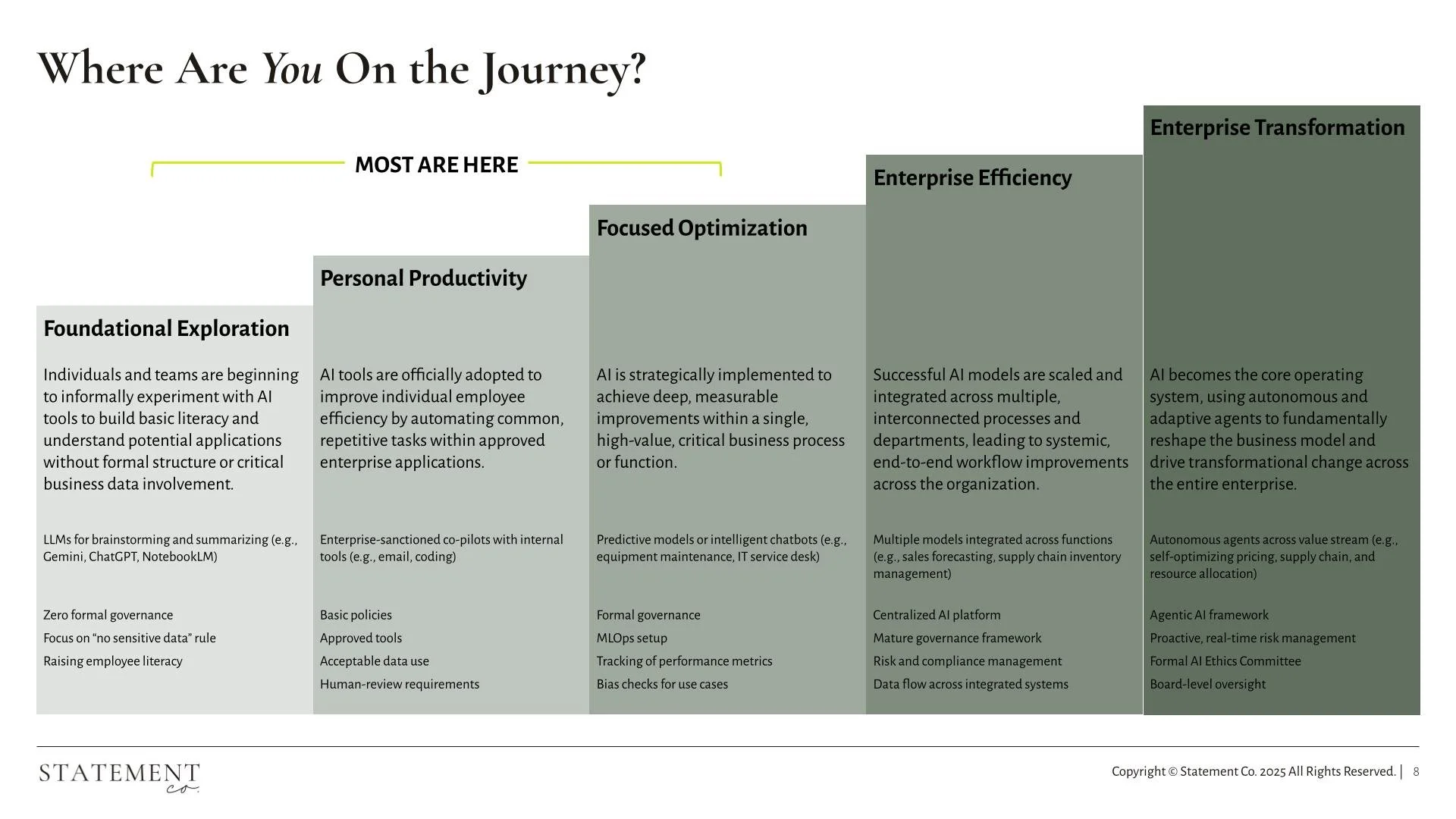
Stage 1 Foundational Exploration: Individuals and teams are beginning to informally experiment with tools like LLMs (e.g., Gemini, ChatGPT) for basic brainstorming and summarization to build literacy. Characterized by zero formal governance, with the primary focus being a strict “no sensitive data” rule.
Stage 2 Personal Productivity: AI tools are officially adopted to improve individual efficiency by automating common, repetitive tasks within approved enterprise applications. Examples include enterprise-sanctioned co-pilots for email or coding. Moves toward basic policies, approved tools, acceptable data use standards, and human-review requirements.
Stage 3 Focused Optimization: AI is strategically implemented to achieve deep, measurable improvements within a single, high-value, critical business process or function, such as using predictive models for equipment maintenance or intelligent chatbots for IT service desks. Formal Governance begins here, requiring an MLOps setup, tracking of performance metrics, and bias checks for key use cases.
Stage 4 Enterprise Efficiency: Successful AI models are scaled and integrated across multiple, interconnected processes and departments, leading to systemic, end-to-end workflow improvements across the organization (e.g., multiple models integrated for sales forecasting and supply chain inventory management). Requires a Centralized AI platform and a mature governance framework that manages risk, compliance, and complex data flow across integrated systems.
Stage 5 Enterprise Transformation: AI becomes the core operating system, using autonomous and adaptive agents across the entire value stream (e.g., self-optimizing pricing or resource allocation) to fundamentally reshape the business model and drive transformational change. Demands an Agentic AI framework, proactive, real-time risk management, a formal AI Ethics Committee, and Board-level oversight.
Where Are Most Organizations Today, Really?
Most organizations today have moved past pure Foundational Exploration. They are currently operating between Personal Productivity and Focused Optimization. They have approved co-pilots and are launching their first critical, high-value use cases.
The challenge is that staying here caps your value. To make the leap to Enterprise Efficiency and Transformation—where AI drives systemic, end-to-end workflow improvements—requires moving beyond fragmented pilots to a comprehensive, enterprise-wide strategy. This leap is defined by the maturation of your governance and the depth of your strategic planning.
How to Scale AI in Your Organization
If your goal is to make AI the core operating system of your business, a rigorous, human-centered roadmap is essential.
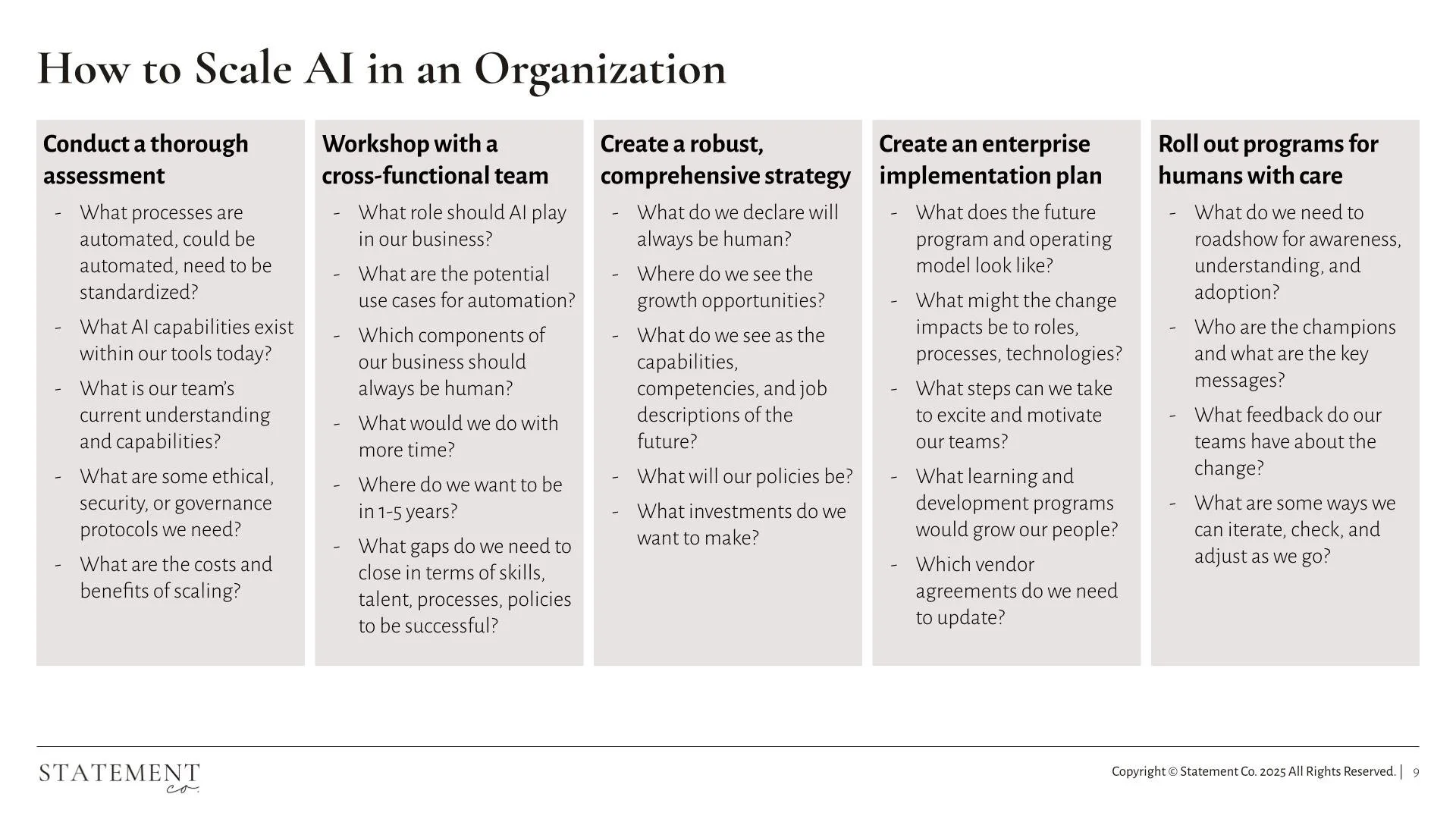
1. Conduct a Thorough Assessment
You cannot build a strategy without clarity on your current state. Start by examining your processes: What is automated? What could be? What needs to be standardized? Assess your existing tools, your team’s current literacy, and, critically, the ethical, security, and governance protocols required for scale.
2. Workshop with a Cross-Functional Team
AI is not an IT project—it's a fundamental business change. Bring together leaders to define the role of AI in your business. This is the moment to answer the most critical question: Which components of our business should always be human to manage priorities, scope, quality, experience, and compliance? Define your 1-5 year vision and identify the gaps in skills, talent, and processes that must be closed.
3. Create a Robust, Comprehensive Strategy
Your strategy must transcend technology investment. Declare what will always be human and define the new capabilities, competencies, and job descriptions of the future. The strategy should align AI investments directly with growth opportunities and establish the definitive policies that govern all use.
4. Create an Enterprise Implementation Plan
Scaling AI is a change management exercise. Define the future operating model and map out the change impacts on roles, processes, and technology. This is where you outline the learning and development programs to uplift your people and the steps required to align vendor agreements.
5. Roll Out Programs for Humans with Care
Technology integration is only one half of the equation. Successful adoption is driven by people. Roadshow your programs for awareness and adoption, identify your champions, and actively solicit feedback from your teams. AI is a powerful tool for your people, and a careful, iterative rollout ensures they are motivated and excited by the change, rather than resistant to it.
Moving toward Enterprise Transformation is a planned journey, not an accident. It requires a clear strategy, mature governance, and a deep commitment to growing your people alongside the technology they will be wielding.
Statement Co. helps leaders unlock personal productivity with AI and organizations scale through facilitated AI workshops to establish a clear program charter and plan for change adoption. In partnership with our global strategic alliances, we bring integrated capabilities to unlock end-to-end AI solutions, helping you architect a future operating model and drive real business value.
Statement Co.llab Contributors: Jess Heaton, PhD and Sarah Cargill